PHIL 109 · Introduction to Formal Reasoning and Decision Making
3 Arguments and validity
This chapter examines arguments and the notions of validity and soundness. It also explains how to use truth-tables to determine whether an argument is tautologically valid.
3.1 Good Arguments
An argument, in the sense used in philosophy, is an attempt to rationally convince an audience of the truth of a proposition (the conclusion of the argument) on the basis of some other propositions (the premises of the argument). Some comments about this characterization are in order. First, the audience of the argument might be one person (for instance, your friend, when you are trying to convince him of something) or several people (for instance, when a politician is trying to convince an electorate to vote for him). It can also happen that the audience of an argument is the very same person who constructs the argument. Sometimes, we “argue with ourselves” in order to figure out what to believe. Second, notice that the kind of conviction that an argument aims to impart in its audience is rational conviction. This is why many times appeals to emotions and other rhetorical devices are classified as fallacies (i.e., attempts to produce conviction through non-rational means).
What, therefore, is a good argument? A good argument is one which succeeds at what it aims: i.e., a good argument is one which gives its audience good reason to believe its conclusion (notice that we characterized an argument as an attempt to produce rational conviction, and attempts can fail). Whether an argument is good does not depend on whether anyone actually ends up convinced by it: people can fail to be convinced by good arguments, and can be convinced by bad ones. What matters is whether the audience should be convinced. For that to be so, two things must hold: first, the audience must be rationally justified in accepting its premises, and second, the premises must offer good reasons to accept the conclusion. Notice that, because of the first condition, goodness is relative to an audience: the same argument can be good for an audience that is justified in accepting its premises and not good for one that is not.
Recall the two arguments we started out with:
- (1) Leona is a cat.
- (2) If Leona is a cat, then Leona is an animal.
- Leona is an animal.
- (1) Leona is an animal.
- (2) If Leona is a cat, then Leona is an animal.
- Leona is a cat.
If you are justified in believing the premises of the first argument (i.e., that Leona is a cat, and that if that is true, then she is an animal), that gives you rational justification for believing its conclusion. So that first argument is well-positioned to be a good one. However, even if you are justified in believing the premises of the second argument (i.e., that Leona is an animal and that if Leona is a cat then she is an animal), that does not give you good reasons for believing its conclusion (that Leona is a cat). There are so many different kinds of animals that it would not be rational to believe that Leona is a cat solely on the basis that she is an animal and that cats are animals. So that second argument is not a good one.
3.2 Validity
Notice an important difference between the first and the second argument: in the first argument, it is impossible for its premises to be true and its conclusion false; in the second argument, it is possible for the premises to be true and the conclusion false (for instance, both premises will be true if Leona is a dog, but its conclusion will be false). We will call this property that the first argument has and the second lacks, validity. We must now make an important clarification regarding the notion of validity.
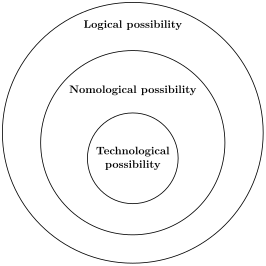
Validity is defined in terms of possibility, but there are different notions of possibility. In one sense, it is impossible for us to transport a million humans to Mars this year—but it is impossible only in the sense that we cannot do it with the technology available to us today. Doing so does not violate the laws of physics. So we say that transporting a million humans to Mars is technologically impossible, but physically (or nomologically) possible.1 Faster than light travel, on the other hand, is nomologically impossible, not just technologically impossible. But it is not logically impossible—the proposition This ship moves faster than the speed of light is not a contradiction. So, as far as possibilities are concerned, everything that is technologically possible is nomologically possible, and everything that is nomologically possible is logically possible:
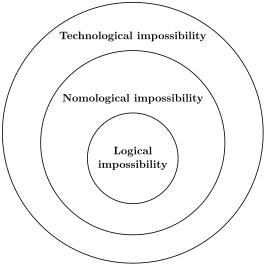
Impossibility, of course, works the other way around: whatever is logically impossible is nomologically impossible, and everything that is nomologically impossible is technologically impossible:
Philosophers sometimes talk of yet a fourth notion of possibility, metaphysical possibility, but we will not be concerned with that one here. So, when we define validity in terms of possibility, which notion of possibility are we using? Logical possibility. When we say that an argument is valid, we mean to say that the proposition asserting all of its premises but negating its conclusion is a contradiction.
Notice that when we say that an argument is valid we are not saying anything specific about the truth-values of its premises and conclusion. What we are saying, again, is that it is impossible for a valid argument to have all true premises and a false conclusion. So, if we are told that the premises of an argument are in fact all true and its conclusion false, that guarantees that the argument is invalid. But any other combination of truth-values of premises and conclusion does not determine whether the argument in question is valid or invalid. For instance, there are arguments with true premises and a true conclusion which are invalid: even though their premises and conclusion are in fact true, it is possible for its conclusion to be false while its premises remain true. Consider, for instance, the second argument we have been talking about:
- (1) Leona is an animal.
- (2) If Leona is a cat, then Leona is an animal.
- Leona is a cat.
As it happens, this argument has true premises and a true conclusion. But it is possible for its premises to be true and its conclusion false. How can we tell that it is possible? Well, a good test is the following: can we imagine a situation where the premises are true and the conclusion false, without falling into a contradiction? Yes we can: we just have to assume that Leona is a dog. Then both premises are true, and the conclusion false, and there is no contradiction. By contrast, there is no way to imagine a situation where Leona is a cat and if Leona is a cat, then Leona is an animal but Leona is not an animal without falling into a contradiction.
Similarly, an argument with false premises and a true or false conclusion can be either valid or invalid, depending on whether it’s possible for its premises to be true and its conclusion false. We can summarize the relationship between validity and invalidity of arguments and truth and falsity of premises and conclusion in the following table:
| Premises true | Premises false | |||
|---|---|---|---|---|
| Conclusion true | Conclusion false | Conclusion true | Conclusion false | |
| Valid | ✓ | ✓ | ✓ | |
| Invalid | ✓ | ✓ | ✓ | ✓ |
The definition of validity has two consequences that students often find surprising. Consider first this argument:
- (1) Leona is a cat.
- (2) Leona is not a cat.
- Lucas plays the trumpet.
Is it possible for the premises to be true and the conclusion false? No, because it is not possible for both premises to be true at all: no logically possible situation is one where Leona is a cat and is not a cat. So there is no situation where the premises are true and the conclusion false, and the argument is valid. In general, an argument whose premises cannot all be true together is valid, whatever its conclusion is. We call such arguments vacuously valid.
Now consider this argument:
- (1) Lucas plays the trumpet.
- Either Leona is a cat or Leona is not a cat.
Here the conclusion cannot be false, so again there is no possible situation where the premises are true and the conclusion false, and the argument is valid. In general, an argument whose conclusion cannot be false (for instance, a tautology) is valid, whatever its premises are.
These arguments are valid, but they are not good. In the first one, the premises cannot both be true, so it is not an argument that could rationally convince anyone of anything, and in the second one the premise does no work at all. This is one more illustration of the point of the next section: validity is not enough for an argument to be good.
3.2.1 Validity, soundness and good arguments
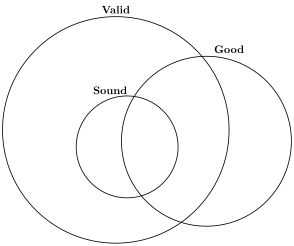
We introduced the notion of validity, and we will soon see how we can use truth-tables to check arguments for tautological validity (i.e., the kind of validity associated with PL). But we need to pause to make a very important point: not all valid arguments are good, and not all good arguments are valid.
It is easy to see that not all valid arguments are good, for some valid arguments have obviously false premises. Given that a good argument must rationally convince its audience of its conclusion on the basis of its premises, an argument with obviously false premises cannot do that. But what about valid arguments with true premises? We call these sound arguments. Aren’t all sound arguments good? Not really. Suppose that you and a friend are trying to convince each other of your respective beliefs: you believe that God exists, your friend believes that God doesn’t exist. One of these arguments is guaranteed to be sound, and yet neither one of them should rationally convince either you or your friend of their respective conclusions:
- (1) God exists.
- God exists.
- (1) God does not exist.
- God does not exist.
We have established, then, that not all valid arguments (and even not all sound arguments) are good. What about the converse, though? Even though being valid is not a sufficient condition for being a good argument, couldn’t it be a necessary condition? That is to say: must every good argument be valid? No. There are good invalid arguments, for there are arguments where, while it is possible for their premises to be true and their conclusion false, this is highly unlikely. If this is recognized by the audience, then the argument may well convince its audience of its conclusion on the basis of its premises despite its invalidity. This is what happens, for instance, with the evidence we have for our best scientific theories: even though the argument from the empirical data to those theories is not valid, belief in those theories (or at least the best established parts of them) is still one of the best supported beliefs we have.
But we do not have to wander into the realm of scientific theories to find good invalid arguments. Suppose you believe that Leona is an animal because I tell you that Leona is a cat and if Leona is a cat then she is an animal. That argument is valid, but your degree of justification in its conclusion cannot surpass the degree of justification you have for believing in its premises. And what justifies you in believing its premises? Well, what justifies you in believing that Leona is a cat is that I told you so (and maybe even showed you some pictures of her). But why do you believe me? Is there a good valid argument whose conclusion is that I never lie? Even I find that hard to believe. Your justification for believing that Leona is a cat, therefore, does not come from a valid argument. And yet you are surely justified in believing that (trust me!). Some will think that what justifies you is not an argument, but many will think that it is an invalid argument—perhaps along the following lines:
- (1) Juan says that Leona is a cat.
- (2) I have no specific reason to distrust Juan on this occasion.
- (3) If I have no specific reason to distrust someone when they say something, then it’s likely that what they say is true.
- Leona is a cat.
If not all good arguments are valid and not all valid arguments are good, why are we interested in this notion of validity? One reason to be interested in it is that validity can be seen as one end of the spectrum in what kind of support the premises of an argument provide to its conclusion. To be good, an argument’s premises must provide good reasons for thinking that its conclusion is true. If it is impossible for its premises to be true and its conclusion false (i.e., if the argument is valid), this is the strongest kind of reason the premises can give. But the goodness of an argument depends on more than what support the premises provide to the conclusion: it depends as well on how justified we are in believing its premises. So, we study validity because it is an important end-point in one of the factors that make for a good argument. In the second part of this class we study probability, which many see as key in understanding the less-than-perfect support that some premises provide to an argument’s conclusion.
We can summarize the relationships between validity, soundness, and good arguments as follows:
3.3 Tautological Validity
Just as we use the language of PL to represent some of the logical structure of natural languages such as English, we will use truth-tables to model the notion of validity. Recall that we say that an argument is valid just in case it is impossible for its premises to be true and its conclusion false. In other words, every possibility where all its premises are true is a possibility where its conclusion is true as well—or, equivalently, there is no possibility where all its premises are true and its conclusion false.
What are these possibilities we are talking about? Philosophers like to talk about possible worlds—consistent and complete ways things could have been. Suppose we think there could have been a talking donkey—i.e., we think that a talking donkey is a possibility. What that means is that there is a possible world that includes a talking donkey—i.e., there is a consistent and complete way things could have been that includes a talking donkey. When we say that a way things could have been is consistent we mean that no contradiction follows from a description of that way things could have been. And when we say that a way things could have been is complete we mean that it answers every yes/no question we can ask about it.
PL gives us a model of possible worlds. Suppose we are working with atomic propositions. As we know, that means that there are possible combinations of truth-values. For instance, if we are working with just these two atomic propositions, Leona is a cat and Lucas plays the trumpet, then they can be both true, both false, or one of them true and the other false, with four total possible combinations of truth-values. In PL, each one of these possible combinations of truth-values represents a possible world. That is to say, in a model with just two atomic propositions there are only four possible worlds—four ways to answer consistently every yes/no question we can ask about every possible truth-functional combination of those two atomic propositions. Of course, the number of possible worlds grows exponentially with the number of atomic propositions.
When we are evaluating an argument, we need to deal only with those possible worlds determined by the atomic propositions involved in the argument—we can safely ignore every other possible world. So, in order to check whether an argument is tautologically valid we follow this procedure: first, we construct a combined truth-table for all the premises and the conclusion of the argument; second we check whether there is a row of this combined truth-table where all the premises are true but the conclusion false; if there is such a row, the argument is tautologically invalid, if there isn’t, the argument is tautologically valid. Let’s illustrate with our two working examples. We start by translating the first argument to PL:
Dictionary
= Leona is a cat.
= Leona is an animal.Formalized argument
- (1)
- (2)
Then we make the combined truth-table:
| Premise 1 | Premise 2 | Conclusion | ||
|---|---|---|---|---|
| T | T | T | T | T |
| T | F | T | F | F |
| F | T | F | T | T |
| F | F | F | T | F |
Try it in the Logic Lab Step through this combined truth table one column at a time.
Notice that the only row of the combined truth-table where both premises are true is row 1, and in that row the conclusion is true as well. Therefore, the argument in question is tautologically valid.
Now let us do the same for the second argument:
Dictionary
= Leona is a cat.
= Leona is an animal.Formalized argument
- (1)
- (2)
| Premise 1 | Premise 2 | Conclusion | ||
|---|---|---|---|---|
| T | T | T | T | T |
| T | F | F | F | T |
| F | T | T | T | F |
| F | F | F | T | F |
Try it in the Logic Lab Step through this combined truth table one column at a time.
In this case, there is a row where all the premises are true and the conclusion false: row 3. Therefore, the argument is invalid. That third row is a counterexample for that argument.
3.4 Translating arguments
The first step in determining whether an argument is tautologically valid consists in translating it from English to PL. By now we know how to translate single propositions into PL, but how do we translate an argument? Well, an argument is built up of propositions, so the first step is just to translate every proposition in the argument. The second, more difficult step, is to determine which of those propositions is the conclusion (the others, of course, will be the premises).2 When we encounter arguments in the wild (as opposed to in a textbook), they do not come neatly arranged with the premises first and the conclusion clearly presented as such. The conclusion might come first, or in the middle, the premises may be mixed in with argumentatively irrelevant data, some premises may be merely implicit, etc. We can be helped in identifying the premises and conclusion of an argument by certain phrases that commonly introduce premises, and others that commonly introduce the conclusion (see the table below). But identification of arguments is part of reading (and listening) comprehension, and can be improved with practice.
| Premise indicators | because, since, for, given that, the reason is, after all |
|---|---|
| Conclusion indicators | therefore, so, thus, hence, consequently, it follows that, must |
Some of these words are better indicators than others. In particular, “must” is a weak indicator of a conclusion: it often marks a conclusion that the speaker has inferred (“Luke must have not paid attention in class”), but it can also express necessity or obligation without signaling any argument at all (“You must be home by ten”). Use context to decide.
Let us end this part with a reasonably complex argument in English, and let us translate it into PL and then use truth-tables to find out whether it is tautologically valid. The following is a reconstruction of the reasoning in a Supreme Court decision in 1952.3 That year, President Truman issued an order directing the Secretary of Commerce to seize the nation’s steel mills during the Korean War to prevent a strike. The steel companies sued the Secretary of Commerce, Charles Sawyer, arguing that the order was an unconstitutional exercise of lawmaking power by the President. The case reached the Supreme Court, which agreed with the companies in an opinion written by Justice Hugo Black. (Justice Robert Jackson wrote a famous concurring opinion with a different analysis, which we will not discuss.) In outline, the reasoning of the majority was the following; what follows is a summary of the argument, not a quotation from the opinion:
The President’s authority to seize the steel mills must come either from Congress or from the Constitution. No statute expressly authorizes the seizure, nor can such authority fairly be implied from any statute. The seizure cannot be justified by the President’s power as Commander in Chief. Nor can it be justified by the other executive powers granted to the President by Article II.
The first step in translating this argument into PL is to figure out what the conclusion is. In this case, the conclusion is not explicitly presented in the passage, but it is clear that it must be something like “The President did not have the legal authority to seize the steel mills.” Once the conclusion is identified, it is easy to see what the premises are. We can now put the argument in a more perspicuous form:
- (1) If the President had the legal authority to seize the steel mills, then that authority came either from Congress or from the Constitution.
- (2) The authority did not come from Congress.
- (3) The authority did not come from the Constitution.
- The President did not have the legal authority to seize the steel mills.
Now we proceed as before, identifying first the atomic propositions and then formalizing the argument:
Dictionary
= The President had the legal authority to seize the steel mills.
= The authority came from Congress.
= The authority came from the Constitution.
- (1)
- (2)
- (3)
Finally, to check for validity we use a combined truth-table:
| Premise 1 | Premise 2 | Premise 3 | Conclusion | |||
|---|---|---|---|---|---|---|
| T | T | T | T | F | F | F |
| T | T | F | T | F | T | F |
| T | F | T | T | T | F | F |
| T | F | F | F | T | T | F |
| F | T | T | T | F | F | T |
| F | T | F | T | F | T | T |
| F | F | T | T | T | F | T |
| F | F | F | T | T | T | T |
Try it in the Logic Lab Step through this combined truth table one column at a time.
The only row where all the premises are true is the last one, and in that row the conclusion is true as well. Therefore, the argument is valid.
Exercises
Use truth-tables to show whether the following arguments are tautologically valid or invalid.
-
Show solution
Valid.
-
Show solution
Valid.
-
Show solution
Invalid: F, T makes the premises true and the conclusion false.
-
Show solution
Valid.
-
Show solution
Invalid: F, T.
-
Show solution
Valid.
-
Show solution
Valid.
-
Show solution
Invalid: F, F.
Translate the following natural English arguments into PL and use a truth table to show whether they are tautologically valid or invalid. Practice translating in the Logic Lab
Jasmine will take a math class if she is interested in math, but she won’t take a math class if she’s a history major. So Jasmine isn’t a history major if she’s interested in math.
Show solution
(: Jasmine is interested in math; : she takes a math class; : she is a history major). Valid: if and were both true, and would both be true.
Curtis will get into Juilliard if he is a great dancer, and only if he practices will he be a great dancer. Therefore Curtis will get into Juilliard if he practices.
Show solution
(: Curtis is a great dancer; : he gets into Juilliard; : he practices). Invalid: F, F, T.
Luke must not have paid attention in his Psychology of Intimate Relationships class. If he paid attention, then his relationship didn’t end, but it did end.
Show solution
(: Luke paid attention; : his relationship ended). Valid (modus tollens).
Aliyah must be hard working if she gets good grades, because she’ll get good grades if she is clever or hard working.
Show solution
(: Aliyah is clever; : she is hard working; : she gets good grades). Invalid: T, F, T.
Ryan Gosling is not famous. After all, if he won an Academy Award, then he is famous, but he has never won one.
Show solution
(: Ryan Gosling won an Academy Award; : he is famous). Invalid (denying the antecedent): F, T.